

 EN
EN  ES
ES UTP sources turbine engines for sale in new, used, and overhauled condition — the full PT6 family of turboprop and turboshaft engines for business aviation, cargo, utility, and commuter operators worldwide.
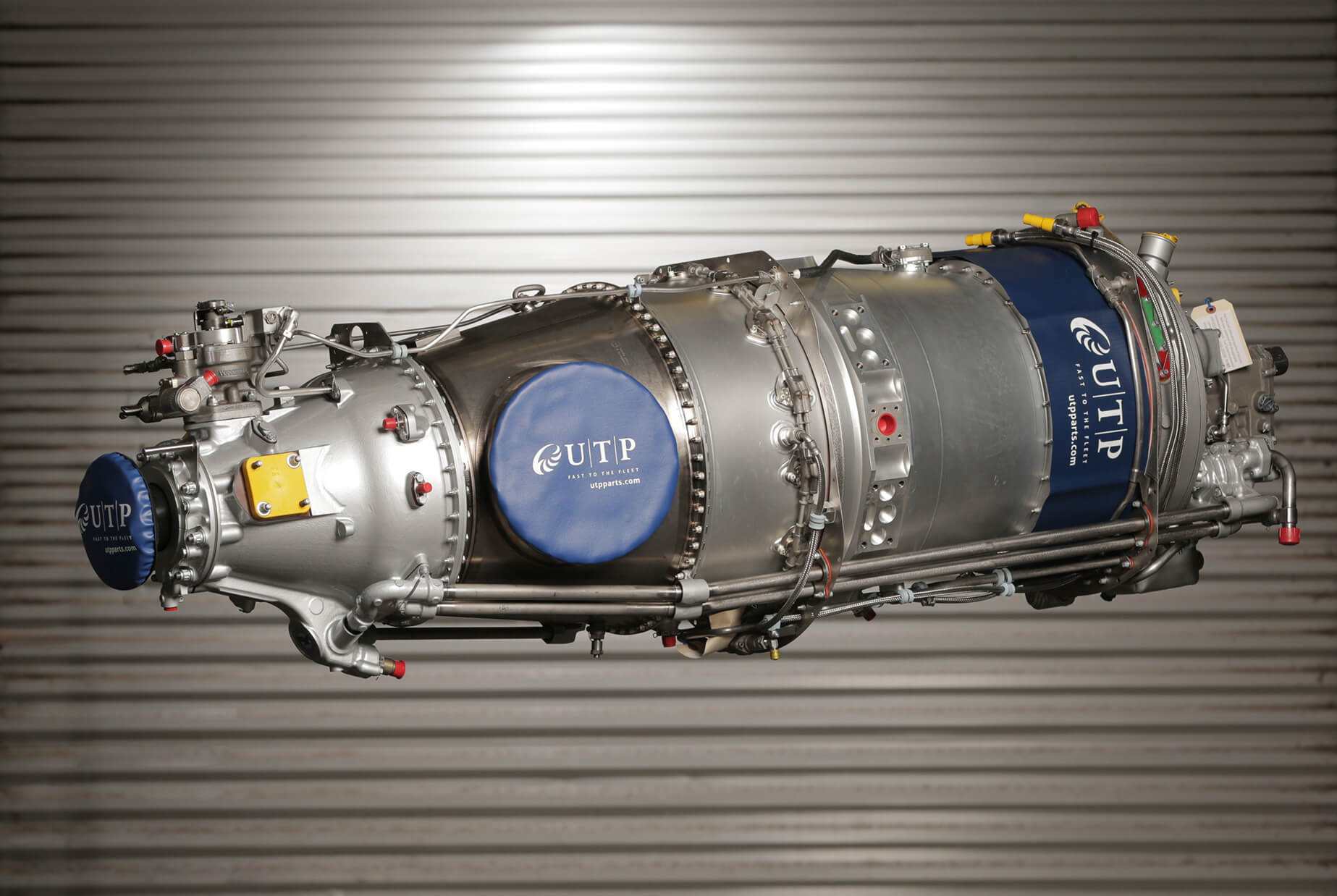
PT6 Turbine Engines: The Industry Standard
When operators across business aviation, cargo, utility, agricultural, and commuter markets search for turbine engines, the vast majority are looking for a PT6—the Pratt & Whitney Canada PT6 family that has dominated general aviation turbine power for over six decades. With more than 50,000 engines delivered across more than 130 certified aircraft types, the PT6 is not just common; it is the benchmark against which all other general aviation turbine engines are measured.
UTP sources PT6 turbine engines across the complete family—PT6A turboprops for fixed-wing operations and PT6B, PT6C, and PT6T turboshafts for rotorcraft — in new, used, and overhauled condition. ASA-100 certification and FAA AC 00-56 compliance apply to every transaction. All engines ship with complete documentation packages.
PT6 Engine Types: Turboprop and Turboshaft
The PT6 family encompasses two primary engine types, each serving distinct aircraft applications.
PT6 Turboprop Engines—PT6A Series
The PT6A series is the most widely used turboprop engine in general aviation. PT6A engines drive a propeller through a reduction gearbox, with the propeller providing primary thrust. A small amount of residual exhaust contributes additional propulsive force. The reverse-flow, free-turbine design gives the PT6A exceptional reliability and enables the power turbine to reach operating speed independently of the gas generator—a characteristic that contributes to the engine’s smooth power delivery and handling qualities.
The PT6A series spans more than 70 certified variants from the 550 shp PT6A-20 to the 1,200 shp PT6A-67R, covering aircraft from light singles to regional commuter aircraft. Nearly every turboprop category in general aviation has a PT6A application.
PT6 Turboshaft Engines—PT6B, PT6C, PT6T Series
PT6 turboshaft variants transmit all power through a shaft rather than a propeller, making them suited for helicopter and rotorcraft applications. The PT6B and PT6C series power a range of helicopters in utility, offshore, and air medical roles. The PT6T twin-pack combines two gas generators driving a single output shaft and powers multi-engine helicopter installations where twin-engine reliability is required.
PT6 Turbine Engine Variants UTP Sources
UTP sources PT6 turbine engines across all power classes and application categories. The table below summarizes the major PT6A turboprop power classes and their primary aircraft applications.
| Power Class | SHP Range | Primary Application | Market Notes |
| Entry / Light | 550–750 shp | Cessna 208 Caravan, Piper Cheyenne, PC-6, agricultural aircraft | Deep; large fleet |
| Mid-Utility | 750–850 shp | Cessna 208B, PC-12/45 early, Pilatus/STOL utility platforms | Strong; active secondary market |
| Business / Twin | 850–1,100 shp | King Air C90, King Air 200, Beechcraft 1900 series | Very deep; multiple overhaul options |
| High-Power | 1,050–1,200 shp | King Air 350, King Air 350i, PC-12 NG | Active; premium market |
| Agricultural / Utility | 680–750 shp | Air tractor platforms, spray aircraft (PT6A-34AG variants) | Active; ag operator network |
| Variant Verification: Always verify the exact PT6 variant designation against the aircraft serial number and Type Certificate Data Sheet before sourcing. PT6A variants are not interchangeable across approved airframes without an FAA-approved STC. |
Why the PT6 Dominates General Aviation Turbine Market
The PT6 market position is not accidental. Several structural factors have sustained its dominance across six decades of production and through successive generations of competing engine designs.
The reverse-flow free-turbine architecture that Pratt & Whitney Canada pioneered in the early 1960s proved exceptionally well-suited to the duty cycles of general aviation: frequent starts and shutdowns, variable power settings, diverse operating environments, and the critical importance of field maintainability in locations far from major overhaul facilities. The PT6 design allows the hot section to be accessed and replaced without removing the engine from the aircraft in many configurations—a practical advantage that directly reduces maintenance downtime and cost for operators worldwide.
The support infrastructure that has accumulated around the PT6 family—hundreds of FAA-certificated overhaul facilities, a global spare parts supply chain, and a community of experienced PT6 mechanics and operators—creates a self-reinforcing ecosystem. New operators choosing a turbine aircraft choose PT6-powered aircraft in large part because the support infrastructure is proven and accessible. This installed base effect makes the PT6 position increasingly durable over time.
Condition Classes: New, Overhauled, and Serviceable
New / Zero-Time
Factory-new PT6 engines in new surplus or current production availability. New units carry the full TBO, complete manufacturer documentation, and no maintenance exposure. Availability varies by variant—current-production variants such as the PT6A-67R are more readily available new than legacy variants where production has ended.
Overhauled / Zero-Time Since Overhaul
PT6 engines restored to new-limits or serviceable condition by an FAA-certificated repair station holding appropriate PT6 ratings. Every overhauled engine ships with a new FAA Form 8130-3. Confirm the facility holds current FAA repair station certification and specific ratings for the PT6 variant at issue.
Serviceable Mid-Time
Operated PT6 engines with documented TSN and TSO remaining. Standard due diligence: complete logbook review, AD compliance verification, and a borescope inspection from an independent A&P mechanic. Mid-time units offer the strongest value relative to acquisition cost for most operator situations.
Run-Out / Core
PT6 engines at or beyond TBO, available for exchange programs or overhaul. Core value depends on variant, TSN/TSO, logbook completeness, and hot section condition. UTP accepts PT6 cores as trade-in toward serviceable or overhauled replacement units across all variants.
How to Source a PT6 Turbine Engine Through UTP
Start with the aircraft. Provide the aircraft make, model, and serial number and UTP confirms the correct PT6 variant designation against the TCDS before initiating sourcing. Provide the required condition class, timeline, and any operational history preferences. UTP presents qualified options with full documentation details.
Support on every transaction includes:
- PT6 variant confirmation against aircraft TCDS and serial number
- Logbook and documentation review before any option is presented
- Pre-purchase borescope inspection coordination
- Core exchange programs across all PT6 variants
- AOG expedite for unplanned removals
- Export documentation and international logistics coordination
All PT6 turbine engines ship with complete logbook copies, current FAA Form 8130-3, and AD compliance summary. EASA Form 1 equivalency paperwork available for international buyers.
Frequently Asked Questions — Turbine Engines for Sale
UTP sources PT6 turbine engines across the full Pratt & Whitney Canada PT6 family, including PT6A turboprop variants for fixed-wing aircraft and PT6B, PT6C, and PT6T turboshaft variants for rotorcraft applications. The PT6A series alone encompasses more than 70 certified variants spanning from the entry-level PT6A-20 through high-power variants exceeding 1,200 shaft horsepower. All PT6 family engines are sourced in new, overhauled, and serviceable condition with full FAA documentation. Contact UTP with your aircraft make, model, and serial number to confirm the correct variant and initiate sourcing.
The Pratt & Whitney Canada PT6 is a family of small gas turbine engines in continuous production since the early 1960s. The PT6A series uses a reverse-flow free-turbine design: air enters the rear of the engine, passes through the compressor and combustion chamber, and exhaust exits the front. The two-shaft design—where the power turbine is mechanically independent from the gas generator—gives the PT6 its exceptional reliability and handling characteristics. Over 50,000 PT6 engines have been delivered across more than 130 aircraft types, making it the most widely used turbine engine in general and business aviation. Its combination of reliability, maintainability, and a global support infrastructure with no practical equal explains its dominant market position.
PT6 turboprop engines (the PT6A series) drive a propeller through a reduction gearbox, with the propeller providing the primary thrust force. A small amount of residual exhaust contributes additional propulsive force. Turboprops are used in fixed-wing aircraft—from light singles to regional commuter aircraft. PT6 turboshaft engines (the PT6B, PT6C, and PT6T series) transmit all power output through a shaft rather than a propeller. They are used in helicopters, where the shaft drives the main and tail rotors, and in some industrial applications. The PT6T twin-pack combines two gas generators driving a single output shaft and powers multi-engine helicopter installations. The correct engine type for any specific aircraft is specified in the Type Certificate Data Sheet and cannot be changed without FAA authorization.
Many operators—particularly those newer to turbine aircraft ownership or transitioning from piston aircraft — know the aircraft type but are not familiar with PT6 variant designations. UTP handles this routinely. Provide the aircraft make, model, and serial number, and UTP cross-references the correct PT6 variant designation against the aircraft Type Certificate Data Sheet before initiating any sourcing. This ensures the engine presented to the buyer is the correct approved variant for their specific airframe, not simply a general PT6A family engine that may not be approved for installation. Starting with the aircraft serial number rather than a variant designation is the correct approach and UTP will handle the technical identification from there.
Every PT6 turbine engine transaction requires an FAA Form 8130-3 airworthiness approval tag confirming the part number, serial number, condition classification, and certifying authority. A complete and continuous logbook from new with no missing entries is required for all condition classes. AD compliance documentation confirming all applicable airworthiness directives have been addressed must accompany every engine. Life-limited components require traceable cycle or hour records from manufacture with no gaps. For overhauled engines, documentation confirming the overhaul facility holds current FAA repair station certification with appropriate PT6 ratings is required. UTP provides all of this documentation with every engine shipped and reviews it before presenting any option to a buyer.
Commercial airline engine procurement operates through OEM-controlled lease programs, airline direct relationships, and a small number of major lessors. The PT6 market is structurally different: a large number of independent operators, MROs, overhaul facilities, and dealers participate in a decentralized secondary market with no dominant institutional infrastructure. This means PT6 buyers benefit from broader market access and more competitive pricing, but also encounter more variability in documentation quality and sourcing practices. Working with an established PT6 sourcing partner like UTP—with ASA-100 certification and FAA AC 00-56 compliance on every transaction—provides quality assurance that the decentralized market does not guarantee on its own.